SUBURBAN SPUNK
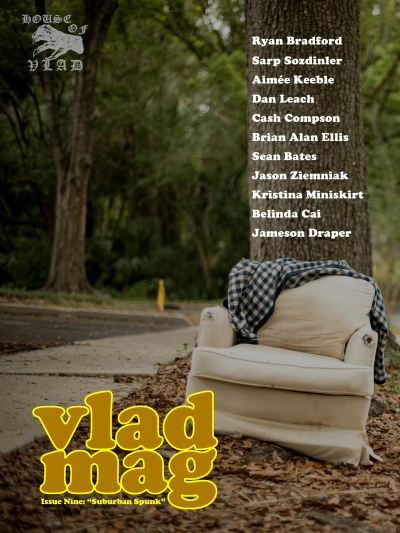
VLAD MAG #9: “SUBURBAN SPUNK”
A HOUSE OF VLAD PRODUCTION
© 2026 by House of Vlad Press
All rights reserved. No part of this content may be used or reproduced in any manner whatsoever without written permission from the publisher, with the exception of excerpts used for critical essays and reviews.
These are mostly works of fiction. Any resemblance to real persons, living or dead, is purely coincidental.
Release Date: October 14, 2026
Guest Editor: D.T. Robbins
Cover design: Percy Hearst
Cover photo © Anthony Verdi
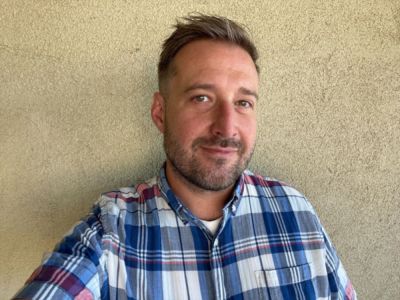
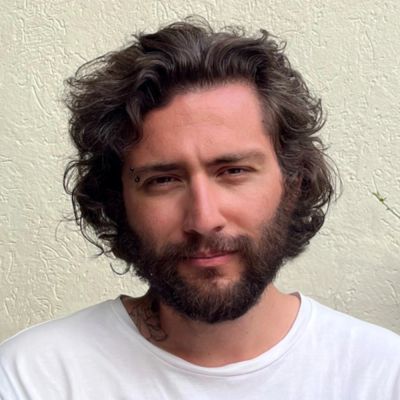
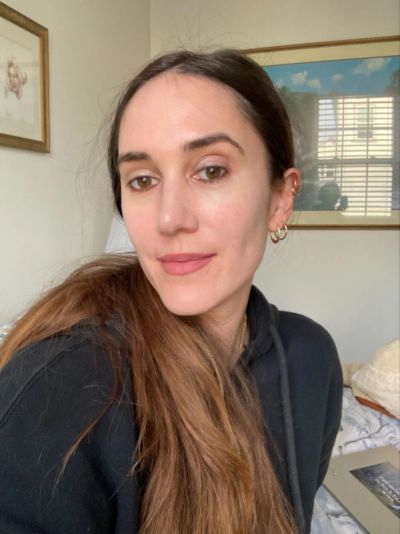
Author photos © the authors
Founder and Editor-In-Chief: Brian Alan Ellis
Contributors: Ryan Bradford, Sarp Sozdinler, Aimée Keeble, Dan Leach, Cash Compson, Brian Alan Ellis, Sean Bates, Jason Ziemniak, Kristina Miniskirt, Belinda Cai, Jameson Draper
Thanks for reading.
HOUSEOFVLADPRESS.COM
RYAN BRADFORD
DAD CHAT
Craig asks for advice with his picky eater. Sean recommends reverse psychology; Todd talks about reward systems. I respond with a picture of myself holding a gun to my head. No reaction. No hahas. I pocket my phone and hit the wizard bong, sucking smoke through his hat while the flame from the lighter chars my thumbnail. Grew the weed myself, and it’s not the best and sometimes I cough up blood, but it saves me roughly $80 a year. My pocket vibrates and it’s Geoff talking about his kid’s bowels. Seems like all these guys want to talk about is if their kids are shitting right. I stay silent because last time they were on this topic, I posted a picture of my own turds to show them an example of a healthy number two, and they threatened to kick me off the thread. Scott jumps in and asks if anyone’s seen the new Pixar, and the guys lose their shit. “Good for kids but there are cool Easter eggs for adults,” says Upton. “Fellini. Ever heard of him?” I respond, but I’m high and accidentally type “felony” because it’s been something I’ve been googling a lot lately. Regardless, Landon gives me a thumbs-up, and I’m so happy that my nose starts to bleed (could be the weed, though). Then Matt sends a video of his little leaguer hitting a home run, assuming we give a shit, but it turns out all the guys do. They’re all so happy for Matt and, by extension, themselves. Good job, Dads! You really nailed it by simply having sperm in your balls! Guess I was the only one who took the vasectomy pact seriously. Nbd. I try to remember when that was. High school? Back then, we talked about how much tail we’d get without the risk of pregnancy. Realize I’ve been voice-to-texting these thoughts and sending them to the group. “Tail?” responds Darvin. “Are you okay?” Craig asks in a separate text. Damn. These guys used to be so much cooler.
RYAN BRADFORD is a writer and educator living in San Diego, California.
SARP SOZDINLER
THERE, THERE, BIG MEAT
My girlfriend said she couldn’t be with someone who kept all his baby teeth in an Altoids tin.
I said, “They’re not all mine.”
She said, “How is that any better?”
It was a fair question. The teeth had been in my family for generations, according to my uncle Rick who gave them to me at Thanksgiving after three bourbons and a small crying spell over the Detroit Lions. He said every man in our family got the tin when he was ready to become the kind of man others could depend on.
I said, “I’m twenty-nine and still Venmo my mom for toilet paper.”
He looked me in the eye and said, “You know what I’m talking about.”
Then he handed me the tin and told me never to open it during a thunderstorm. Obviously, I opened it during a thunderstorm. Nothing happened at first. A bunch of tiny teeth, rattling around like old popcorn kernels. Then a lightning popped outside, the lights went out, and a voice from inside the tin said, “Goddamn it.”
I dropped the tin. The teeth spilled across the kitchen floor. They began vibrating, scooting around, clicking together. My girlfriend screamed and jumped on a chair. The teeth arranged themselves into the shape of a little man, about six inches tall and with no skin.
He looked up at me and said, “What’s up, chief?”
I said, “What are you?”
He said, “Family.”
My girlfriend said, “Nope,” and climbed out of the kitchen window to the fire escape even though we lived on the first floor and the front door was right there.
The tooth man told me his name was Craig, that he’d been advising the men in my family since the late 1800s. He said my great-grandfather used him to pick mules, my grandfather used him to survive Korea, and my dad used him to decide whether or not to get a mortgage.
“How did that go?” I asked.
“What do you think?” Craig said, which was a fair statement to make about my family.
I told Craig I didn’t need advice from a tooth homunculus.
Craig said, “Oh, you bet. You sleep on a bare mattress and eat shredded cheese from the bag every day like it’s trail mix.”
Again, fair. Goddamned Craig. So, I let him help. First, he told me to apologize to my girlfriend. I texted her, sorry i scared you / i understand how that was a LOT.
She texted back, lose my number, dracula.
Craig looked me in the eye and said, “She’s not the one.”
After that, Craig improved my life a whole lot. He told me to get renter’s insurance. He told me to stop saying “circle back” in emails. He told me to ask my boss for a raise and then recited me the exact words to use over the phone. I got four thousand more a year and a Chili’s gift card.
Craig moved into a shot glass beside my bed. At night, I’d hear him grinding himself together, which he said was normal and nothing weirdly sexual. We became close like that. Sometimes we watched basketball together. Sometimes I carried him around in my shirt pocket and he’d call strangers “bozo” in a voice only I could hear. He hated birds, tall lamps, most soups, and my downstairs neighbor Kevin who played bass.
One night, Craig said, “You should call your dad.”
I said, “No thanks.”
He said, “He’s dying.”
I said, “He’s always dying. That’s kind of his thing.”
But Craig wouldn’t let it go, so I called.
My dad answered on the fifth ring: “What?”
That was his hello.
I said, “Hey.”
He said, “You need money?”
I said, “No.”
He said, “Then what?”
Craig twisted my nipple from inside my pocket.
I said, “Ouch.” I said, “I just wanted to see how you were doing.”
There was a long pause. I could hear his TV in the background. Some courtroom show. Somebody objecting to a stupid charge.
My dad said, “I’m okay.”
I said, “Good.”
He said, “You?”
I said, “I’m okay, too.”
Then neither of us said anything for a while. It was the best conversation we’d had in years. A week later, he died at a car wash. Not inside the car wash. Outside it, arguing with a teenager about skateboards. His heart gave out while he was holding a little pine-shaped air freshener.
At the funeral, I kept Craig in my pocket. He was quiet the whole time. Even when my aunt Linda sang “Amazing Grace” like she was trying to kill it. Afterward, I went to my dad’s apartment to clean things out. It smelled like dust and old beans. The carpet was all rotten from the edges and kind of sad looking. I found on his dresser a shoebox full of birthday cards he’d never sent me. All thirty years of them. Some had money inside. Some just said Love, Dad in his shaky handwriting.
I sat on the floor and opened every card one by one. Craig climbed out of my pocket and stood on my knee.
“I tried to help him too, you know,” he said.
“What happened?”
Craig shrugged with all his little teeth. “Some people just don’t like to listen.”
I laughed, then cried, then laughed a bit more because Craig patted my leg with a molar and said, “There, there, big meat.”
That night, I dreamed my dad was tiny enough to fit inside a shot glass. He was sitting beside Craig, each drinking from a bottle cap.
My dad said, “You turned out okay.”
I said, “Barely.”
When I woke up, Craig was gone. The Altoids tin was empty except for one tooth I recognized as mine. A front tooth I’d lost when I was seven, after my dad pushed me too high on a swing and I flew off laughing like an idiot.
I put the tooth in my mouth. It still fit perfectly.
SARP SOZDINLER is a writer from Philadelphia and Amsterdam. His work has been published in Electric Literature, Kenyon Review, Wigleaf, HAD, X-R-A-Y, Pithead Chapel, Maudlin House, and elsewhere. He edits the literary journal The Bulb Region.
AIMÉE KEEBLE
BRUCE WILLIS
I am worried about Bruce Willis and the breastfeeding
His daughters are always online breastfeeding
Will the breastfeeding in front of him confuse him?
I have no issue with breastfeeding
I support breastfeeding in public or wherever it needs to happen
But I am worried that in his condition he will become troubled
I am of sound mind
and so whenever I see breasts accidentally or
intentionally in public I understand the context and
therefore am neither turned on nor embarrassed
for myself or whomever else
But Bruce Willis has no verbal powers left
I am worried he is staring at the breasts of his daughters
as if they were holding a pair of slightly decaying roses
to the lips of a cupid
I am worried he will think he is dead already
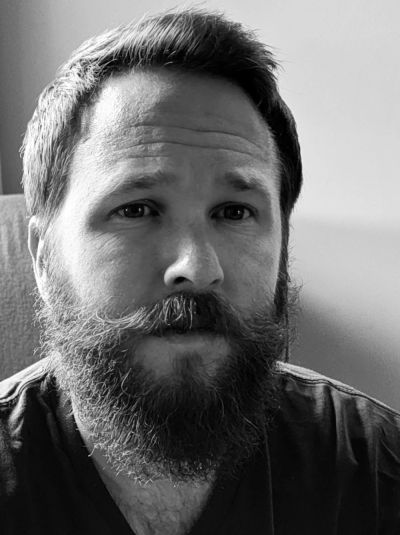
AIMÉE KEEBLE holds a Master of Letters in Creative Writing from the University of Glasgow, the alma mater of her great-uncle Alexander Trocchi. She has exhibited her work at Flint Gallery in Norwich, theprintspace in London, the Superette Gallery in Paris, and Circolo del Design in Turin, as part of Never Turn Back, a photography/poetry project in collaboration with Dean Chalkley. She is the co-founder of The Crawfish and is represented by Stephanie Cabot at Susanna Lea Associates.
DAN LEACH
AMATEUR MAGIC
There was that one house with the smell. That’s what we called it, “the house with the smell,” and anywhere you wanted to go—the creek, the cul-de-sac, the store—you had to pass by it. Its vinyl was brownish-yellow and falling off in strips in a way that made you think of peeling skin. We asked our parents who lived there. Even they didn’t know.
Weirdest was how the smell was always changing but also always the same. Sometimes, such as the morning, we found a family of racoons behind the old Army-Navy store, it smelled vaguely of cabbage (only sweeter) but also like something kind of metallic (maybe copper). Other times, such as the night, we snuck out to watch the meteor shower, the smell was warm and somewhat meatish, as if some animal you didn’t know existed had just been cooked into a very thick stew. But underneath these braided variations, there was a single discernable scent, which is what everyone meant when they mentioned “the smell.”
I once got drunk and called someone from the old neighborhood, a woman I had not spoken to in nearly thirty years. For half an hour, I pretended to have actual business to discuss with her, after which, I slipped in, as if it had only just occurred to me, a question about the house with the smell.
“My mom told me a witch lived there,” she said, “so I always thought it was potions.”
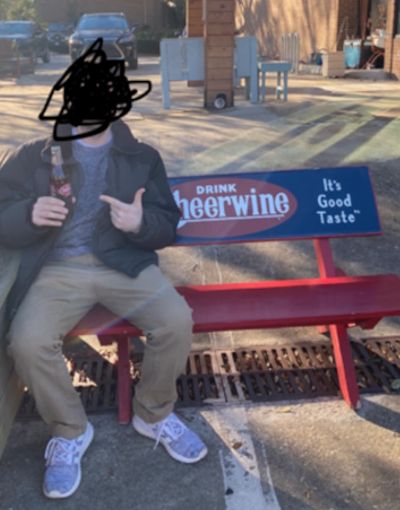
DAN LEACH wrote Junah at the End of the World (Hub City Press) and lives in the low country of South Carolina where he works as a short-order cook at a small Baptist college.
CASH COMPSON
BLESS ME, CHARLOTTE
Everybody who sleeps naked is cooler than I
am. Crank the air and drive me home when I’m
reeling. You’re endless and you’re elsewhere. I stock words
in your crevices like moonshine lowered into
holes that go all the way to hell. O winter. O woesome
meltdown. Done like dinner. Original recipe and
far from feeling. I cannot wait for your
summer thunder to shimmy down. Bless me somewhere
new on the map
in your swamp beneath your feet in the rivers
that flee your legs aghast prescribed, your purpose
so I can go the fuck to sleep
somewhere beyond
everything you hate to hear when we’re out late
between the party and the coma
your bedtime hair something I see
at night until you stop me
CASH COMPSON wrote People Scare Me (House of Vlad, 2024) and lives in New England.
BRIAN ALAN ELLIS
TIME OF MY LIFE
Like most single, romance-starved women her age in 1987,
Mom’s favorite movie was of course Dirty Dancing,
and the Patrick Swayze ballad from said film,
“She’s like the Wind,”
was everywhere and everything that year.
I breathed it in
over bowls of soggy Fruity Pebbles
as my crazy-for-Swayze mother drank coffee
and chain-smoked Kent Golden Lights
on our porch with FM radio in her ears
and shit-talk in her heart—
mostly petty grievances over neighbors,
family, friends (both hers and mine),
and coworkers at McDonalds,
where she spent most nights salting fries
and stealing Happy Meal toys for me.
The song reverberated
off the thin mobile home walls,
imperiously,
matched only by the sound my
Nintendo controller made
whenever I threw it angrily
at humidity-warped shelves
holding up G.I. Joe action figures
and those big, rubber, anxiety-chewed
LJN WWF monstrosities, “The Immortal”
Hulk Hogan leading the pack.
“She’s like the Wind”
was the soundtrack to me getting pummeled,
mercilessly, by Mike Tyson in Punch-Out!!
as a Freddy Krueger poster cast a chuckling,
mischievous shadow, my voice harmonizing
crudely with Swayze’s.
“Fuck you, Mike,” I would then mutter,
defeatedly retrieving my thrown game controller.
“And fuck you too, Freddy.”
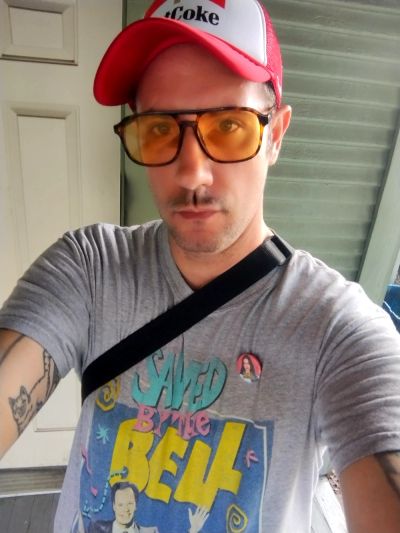
BRIAN ALAN ELLIS has published several books, including The Errors Tour. His writing has appeared at Juked, Hobart, Monkeybicycle, Fanzine, Electric Literature, Vol. 1 Brooklyn, HAD, X-R-A-Y, Heavy Feather Review, Rejection Letters, BULL and Forever Magazine, among many other places. He lives in Florida.

SEAN BATES
BULLY
Last summer my elementary school bully died. He was speeding on a motorcycle. Took a hard turn or swerve or something. I saw the cross and the flowers and the crunch in the guard rail. He’d been drunk. I think. A young and weird hate bloomed in my stomach acid. Idiot. Made me feel like we’d split at a fork somewhere and here I am, self-congratulatory that my choices have been different. Which is extra fucked up because I never knew him as an adult so. In my mind. A kid is dead. Easy to find the obituary. Easy to find the online memorial. One comment said good riddance. The next winter. Another kid I knew in fifth grade died. He’d been blessed: large, prominent front teeth. I remember. He was reminded mercilessly during the whole of fifth grade by the now late bully. I never stood up for him. This other kid had died in Iowa. He was drunk in a car. Speeding on the highway. I don’t know who was driving. His friend and girlfriend died too. Newspaper said he’d become an angel. I wonder why these two were burned in my memory. I wondered when I’d given up on immortality.
SEAN BATES is a writer and educator in Western Massachusetts by way of Upstate New York. He earned his MFA in poetry from UMass Amherst. His poems appear in Paddler Press, Emerge Literary Journal, Stone Canoe, Rising Phoenix Review, and What Saves Us: Empathy and Outrage in the Age of Trump, edited by Martín Espada.
JASON ZIEMNIAK
THE GRAIL
Face down under a moldy copy of Frampton Comes Alive I saw the sleeve first. The cover was drawn with a red pen.
It said SCHOOL SUCKS on the front. All scrawled letters. Under it was a drawing of a kid kicking a desk through a classroom window while a teacher cried, holding a globe.
I almost missed it. Every collector has one record that lives in his brain like a parasite. Mine was this thing. Rumors only. A ghost pressing from 1983. Recorded by some middle school kid and his cousins in a garage somewhere in Missouri or Alabama. Nobody knew. People argued about it in zines for years. One guy claimed only twenty copies existed because the mother found the rest of the records in the garage and smashed them with a tire iron.
The guy behind the counter said two bucks.
Got it home. Sat it on the turntable. My dog left the room.
Side A has fourteen songs. Fourteen kicks in the teeth. The kid sounds like he is twelve or maybe eleven. Voice cracking apart from fury and puberty at the same time. He hates his school. He hates his teachers. He hates homework. He hates the principal. He hates the bell. He hates lined paper. He hates the pledge of allegiance. He hates gym class. He hates history. Film strips. Fire drills. Math. Pencil sharpeners.
The band behind him plays like their instruments are on fire and they are trying to put themselves out. Guitars sound like glass being dragged down a dirt road. The drums are machine-gun fast. The bass is a middle finger. Every song is under a minute. Most are under forty seconds. No breaks. No apologies.
Track six was called NO MORE BOOK REPORTS. Eighteen seconds long. Near the end you hear somebody in the background yell “YOUR MOM IS HOME” before the whole thing collapses.
It is perfect.
Then Side B.
One track. It is not even listed. Just says BURN SESSION in small letters at the bottom.
I drop the needle.
At first there was nothing. Room noise. Somebody breathing close to the microphone.
Then a lighter flicked.
Paper crackled.
The kid started muttering.
“Fuck school.”
Quiet at first. Almost thoughtful.
More crackling. The sound of pages curling inward from heat.
“Fuck school.”
Long silence.
Then again.
“Fuck school.”
Over and over.
For eight straight minutes.
No music.
No drums.
Just a child burning his report card while whispering hatred into a cassette recorder like he was reciting prayers beside a deathbed.
By minute five the smoke alarm starts chirping in the background.
Nobody turns it off.
I sat alone in my apartment listening to this kid, who was now probably pushing sixty or dead from chain smoking and prison cafeteria meat.
When it ended the needle kept ticking against the center groove.
I realized I was crying a little.
Not from sadness exactly.
Recognition.
That record did something holy.
Not because it was rare.
Not because collectors wanted it.
Because for eight minutes some unknown kid from 1983 achieved total honesty.
No poetry.
No cleverness.
Just fire and rage and the absolute certainty that school had taken a bite out of his soul and he wanted something back.
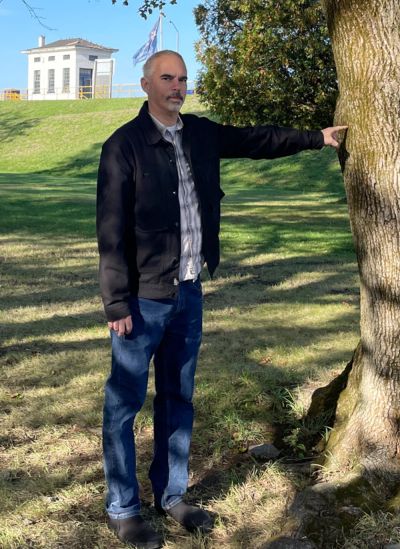
JASON ZIEMNIAK runs Chrome Peeler Records and lives in Niskayuna, New York, with his wife.
KRISTINA MINISKIRT
PART 5: PAYOFF
For the Female Spirits of the dead, pining in bonds of religion,
Run from their fetters; reddening, and in long-drawn arches sitting,
They feel the nerves of youth renew, and desires of ancient times
Over their pale limbs, as a vine when the tender grape appears.
—William Blake, America: A Prophecy
I cry on Mondays
I scream on Tuesdays
I fuck on Wednesdays
I kill on Thursdays
On Fridays I smile so big
My life is full
My arms are skinny
My bag is stylish
My haircut has perfect layers
My shoes don’t cause me pain
I can walk forever towards nothing
I can rip out my womb and give it away
I don’t face consequences for my actions
I don’t need to eat or breathe to be happy
I’m meeting my Twitter friend Bella Swan for drinks. I don’t have any opinions on her character. She stabs me in the hand with a fork. I wish we could share memories. She laughs at my blood, I didn’t know I still had any left to spill.
I can’t feel either, she says. She dares me to stab her back. I pick up my fork with my unstabbed hand and tighten my fist around the handle and let my nails dig into my palm. I looked at her hand and then at her grin, and then at her eyes, white and flashing. I ask her if she likes disco, if she thinks we’re Gods or evil, if we’re lambs, if she’s a virgin, if anything bad has happened to her.
I can’t stab her back and I apologize. She shrugs and takes the fork out of my hand. We leave together and walk in the cold. She says good night and I wave with my bloody hand.
I walk uptown for miles
I cross the bridge, the river, the bridge, the river
Fields turn to deserts, sand becomes pavement
White lines move across the pavement until a grid forms, empty
I scale a fence
I lose a shoe, then the other
I step on broken glass and mud
I expel my guts a few times, empty
I come to a building, and it opens with an inhale
I walk up the stairs and come to the second door
My breath syncs with my pulse
The wound on my hand heals quickly as I reach for the knob
I twist it, steady, straight-spined, clear-eyed
No push and it opens and shows me a mirror
I see my reflection, small and fresh like a bunny
And with the rest of my life
I hold my daughter
KRISTINA MINISKIRT is an American woman.
BELINDA CAI
TWO POEMS
mary janes
slip the short bouffant dress
over her pigtailed head
her big, dark eyes stare
no different than a doll’s
mommy’s little asphyxiated princess
pretty and deranged in pink
if you peel away the porcelain,
there’s a sucrose-fueled gooey core
with a tree-climbing pair of
scraped up knees stretching down to
glossy mary janes you call píxié’s
delicate and feminine bound feet
bound like great grandma’s
torturous and slick so she can’t make it
above the first branch
and she wants nothing more
than to rip off the rosy tulle
buff the shine out of her shoes
move up and up and up
and up and up (and away)
into the trees
where they meet the clouds
her head always in the clouds
do you ever ache to ache?
when the sadness vanishes, i fear i will too / who am i without it / the lamotrigine is working / i may also never quit benzos / i’ve built something new after the carnage / worked very hard on it / do you wanna see? / sorry, it’s still a WIP / a whip / my boyfriend in college said no one should be medicated for insanity / not even the worst kind / that we need people in this world who are deeply, deeply fucked up / for art, he said / for heterogeneity / we can’t all be well / do you ever ache to ache? / the truth is, i sometimes do / it’s the too-tight hug that knocks the wind out of you / but a hug nonetheless
BELINDA CAI is an L.A.-based writer and musician. Her work has been featured in VICE, Tinder, NPR, Hobart, Entropy Magazine, Bitch Media, Car Crash Collective, Burial Magazine, Dream Boy Book Club, Midcult, and more. She received an M.S. in Journalism from the University of Southern California.
JAMESON DRAPER
AT THE EDGE OF THE WIND
One day, you will wake up and leave the only place you’ve ever known. You will spend the whole day prior purging your thoughts with labor. You will load into the U-Haul the tables, chairs, booze, plates, cutlery, nightstand, books—oh, lord, boxes of books—nonperishables, one or two televisions, bags full of clothes, shoes, an expired Xanax you’ve been saving since 2014, couch, jackets, mirrors. Entire panels of hardwood floors that haven’t been seen in half a decade become exposed under a film of dust. You will walk around the cavernous home, and your steps and voices will bounce off the barren walls and echo across the empty room.
You’ll get a beer with your ex-girlfriend. You have been waiting to escape her clutches for almost a year, but now that it’s happening, you’re scared. You’ll look into her sad eyes and remember the good times, like when you jumped off a slick black cliff into Lake Superior, or the drive home from Chicago in the dead of night on a sheet of ice and having the thought that if we died, at least we’d die together. You’ll remember that she saved your life and the only thing she asked for was your presence, her wet and terrified eyes under the artificial glow of yellow hospital lights. You’ll remember her coming home drunk at three in the morning with her Kia parked halfway onto the neighbor’s lawn. You’ll remember sitting on your patio, smoking, watching her feed the neighborhood strays. You’ll remember the way her sweat smells after a long shift, that indescribable, unmistakable stench of a kitchen. It all feels so long ago, even though you haven’t even left it yet. You’ll remember your parents. Your sister. Your friends. You’ll think about long lost frigid pink dawns, rolling up manual window cranks in deteriorating sedans thick with weed smoke and a busted speaker that hums Chief Keef. You’ll think of tepid swampy nights, shooting hoops on crooked baskets in the gloaming until nobody could see the ball. You’ll think of summer days on scorched pavement at car shows, the smell of motor oil and moth balls, your grandpa’s gruff voice testing your knowledge of domestic makes and models.
You’ll drink two tall beers and drive home. There will be industrial fireworks launching off your street, leftovers from Independence Day. You’ll walk inside your house and see the only things left are a sleeping bag and a cat. You’ll share the sleeping bag with your ex, and you’re pretty sure this is the last time you two will ever touch. You’ll hope she forgets you, but you know she won’t. You’ll sleep poorly because the floor is hard and cold and stare at the popcorn ceiling, listening to the sweet fiery songs of cracks and sizzles from explosives outside. You’ll inhale deeply and hope you won’t forget the way this house smells, but you will. You’ll forget all the details sooner than you could ever imagine.
Before dawn, you will rise in the middle American darkness and give her a kiss goodbye on the forehead. You’ll take your key off your ring and leave it on the floor beside her. You’ll pick up your cat and walk out the door for the last time. You’ll throw him in the passenger seat on a blanket you left for him, but he instead sits in your lap for the whole ride. You’ll drive off in the glow of the morning aurora, violet and orange, and see the mist deposit its dew on manicured lawns. You’ll stop at the gas station on the corner and look around. You’ll get back into your U-Haul and drive toward the highway. Eight hours to go. As you roll onto the entrance ramp you look back in your rearview mirror and see the sky turning pink and blue, the crumbling factories and bungalows disappearing into the fog. You don’t know it yet, but once you leave, you can’t come back. Not really. The only home you’ve ever had isn’t alive any longer. You also don’t know it yet, but this is the best decision you’ll ever make. So, for now, only melancholia, FM radio, your cat in your lap, and the open road ahead. Listen to the creaking rattle of the axles on the old truck. You can only go forward, never back, because that’s what you do when you can’t go home anymore.
JAMESON DRAPER is from Detroit but lives in Baltimore. He bruises at Bruiser Mag and edits fiction at Michigan City Review of Books. He lives with his girlfriend and two cats. He loves Negronis, baseball and the smell of rain.

ABOUT THE GUEST EDITOR
D.T. ROBBINS wrote Leasing (House of Vlad, 2024) and Birds Aren’t Real (Maudlin House, 2023) and is the founder and publisher of Rejection Letters. He lives in Southern California.